Policy rules
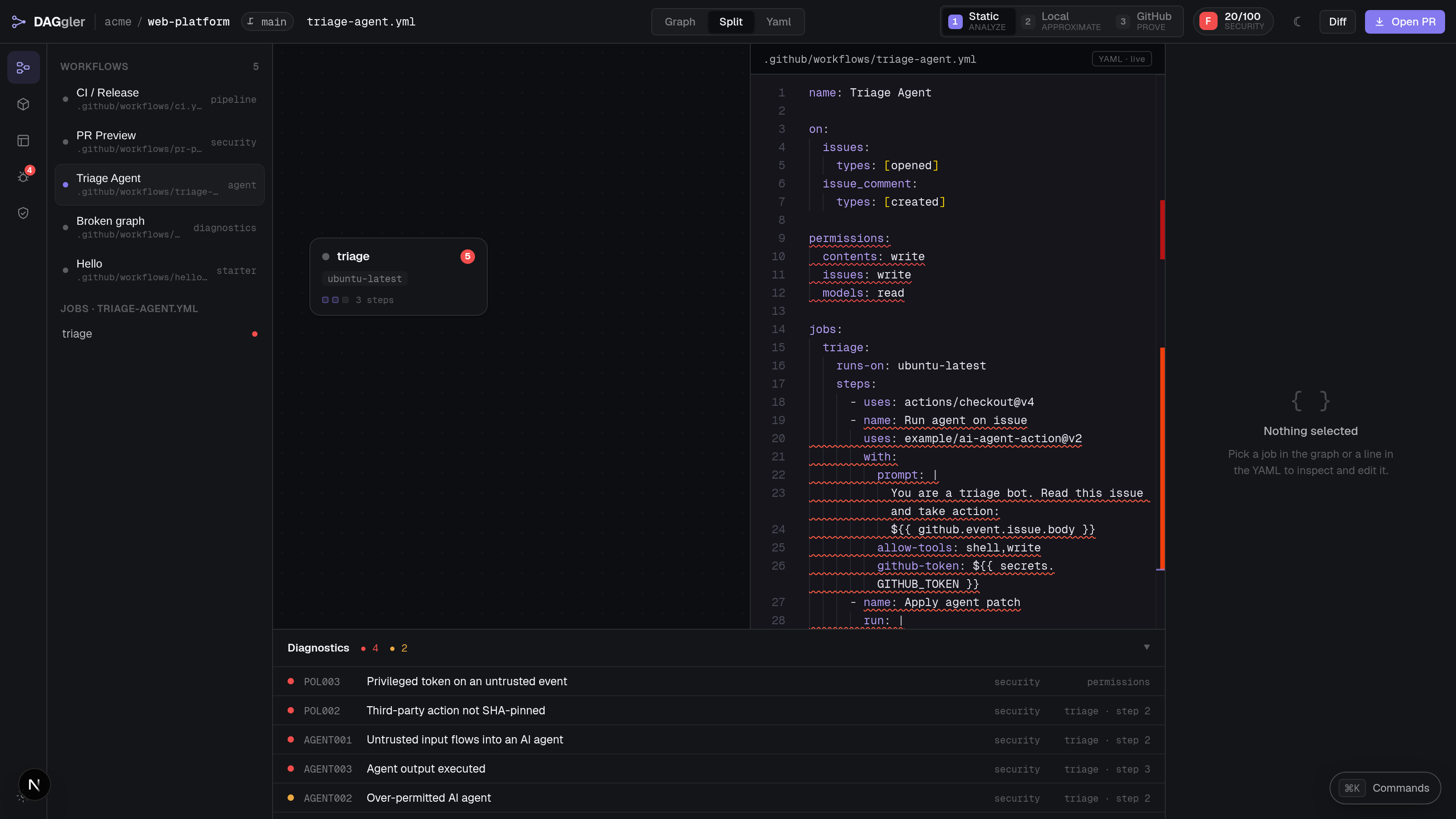
Thirteen pure rules run over the parsed workflow, on top of the five validation layers. Each finding has a code, a severity, a source location and a message that says what to do. The findings feed a security score from 0 to 100, graded A to F per workflow (F 0/100 for the example on the home page).
| Code | Severity | Title |
|---|---|---|
| POL001 | warning | No top-level permissions block |
| POL002 | error | Third-party action not SHA-pinned |
| POL003 | error | Privileged token on an untrusted event |
| POL004 | error | Secret reachable from untrusted event |
| POL005 | warning | Broad contents:write on PR workflow |
| POL006 | warning | Deploy without environment gate |
| POL007 | error | Action ref uses a branch |
| POL008 | error | Shell injection from untrusted input |
| POL009 | warning | OIDC permission without a cloud step |
| POL010 | warning | Workflow modifies workflow files |
| AGENT001 | error | Untrusted input flows into an AI agent |
| AGENT002 | warning | Over-permitted AI agent |
| AGENT003 | error | Agent output executed |
An untrusted event is one that runs with the base repository's privileges while handling content an outsider controls, such as pull_request_target or issue_comment.
Permissions and tokens
POL001: No top-level permissions block
Without an explicit permissions: block the workflow inherits the repository's default token scopes, which are often read-write. Declare the minimum at the top, then widen per job.
permissions:
  contents: read
POL003: Privileged token on an untrusted event
A job on pull_request_target, issue_comment and similar events that is granted write permissions can be driven by an attacker. Drop the write scope or move the privileged work to a workflow that does not process the outsider's content.
POL005: Broad contents:write on PR workflow
A workflow triggered only by pull_request and holding contents:write is broader than it needs to be, and pull requests can come from external contributors. Prefer contents: read and do writes in a separate push or release workflow.
POL009: OIDC permission without a cloud step
A job granting id-token: write with no recognised cloud-auth action probably has a permission it does not use. Remove it or add the cloud login step.
Supply chain
POL002: Third-party action not SHA-pinned
uses: owner/action@v5 follows a mutable tag the action's author can move. Pin third-party actions to the full 40-character commit SHA (keep the tag in a comment). In the editor, the Pin to SHA quick-fix does this from API-verified SHAs.
POL007: Action ref uses a branch
uses: actions/checkout@main runs different code on different days. Pin to a release tag or, better, a full commit SHA.
POL010: Workflow modifies workflow files
A step that writes into .github/workflows/ can change other workflows and bypass review gates or escalate privileges.
Secrets and injection
POL004: Secret reachable from untrusted event
When an untrusted event triggers the workflow and a step references a secret other than GITHUB_TOKEN, attacker-controlled code can exfiltrate it.
POL008: Shell injection from untrusted input
Interpolating an attacker-controlled field such as github.event.pull_request.title straight into run: lets the author inject commands. Pass the value through an environment variable and quote it.
- run: echo "Testing $TITLE"
  env:
    TITLE: ${{ github.event.pull_request.title }}
POL006: Deploy without environment gate
A job that looks like a deploy (the name or id contains deploy, release, publish or promote; it uses a cloud-auth action; or it grants id-token: write) with no environment: has no required-reviewer protection. Add an environment: and configure reviewers in the repository settings.
AI-agent workflows
AGENT001: Untrusted input flows into an AI agent
Putting issue or pull request text directly into an agent's prompt on a privileged trigger enables prompt injection.
AGENT002: Over-permitted AI agent
An agent step granted shell, write or exec tools together with a repository token has a large attack surface: a manipulated model response can run arbitrary actions.
AGENT003: Agent output executed
A run: step that takes output from an earlier agent step and feeds it to git apply, | sh, eval or similar turns model output into code.
Policy packs
Rules are grouped into six packs, so a team can switch on the set that matches its situation: oss-maintainer, enterprise-least-privilege, release-hardening, ai-agent-safety, docker-publishing and cloud-deploy.